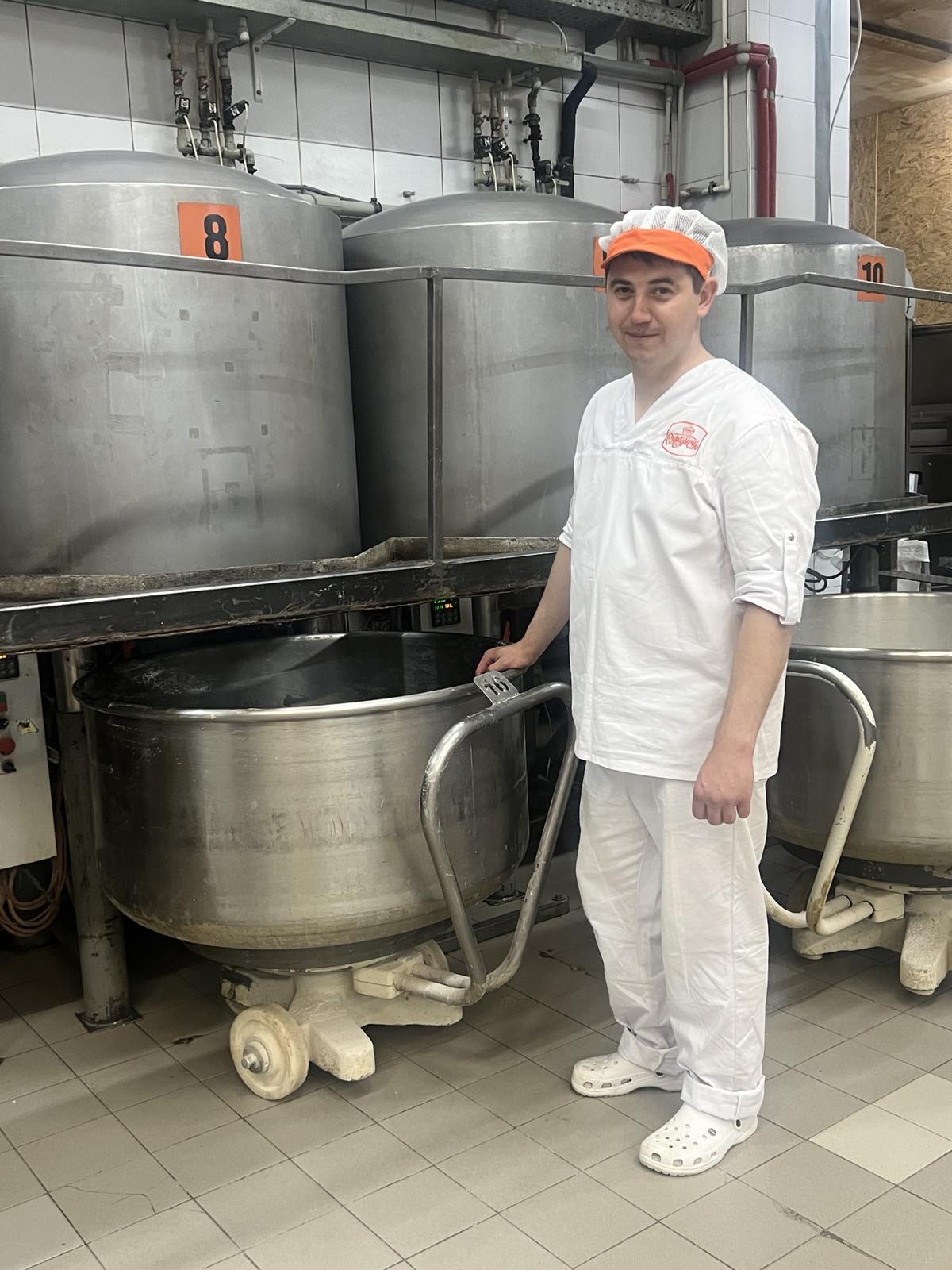
Where the True Taste of Bread is Born: An Interview with the Dough Master
Behind every fragrant loaf of bread we are used to seeing on our tables lies not just an automated production line, but a complex biological process. We rarely stop to think why one loaf stays fresh for days while another goes stale almost instantly. The answer lies at the very foundation: in sourdough starters, scalds, and sponges.
Today, we are talking to someone whose profession remains behind the scenes but is absolutely critical for quality — a Raw Material and Food Product Fermentation Specialist (traditionally known in Ukraine as a Varnyk or Dough Master). This is an expert who interacts with live cultures every day, literally creating the heart of the future bread.
- What does it mean to be a fermentation master, and what role does this profession play in bread making?
Being a fermentation master means being responsible for the biological and flavour foundation of the product. My main task is to prepare complex dough bases: sourdough starters, scalds, and sponges.
Our production relies on a "long-fermentation" method, where the process of creating these bases takes anywhere from 12 to 42 hours. This time is essential for all the components to fully mature and unlock their potential. It is thanks to these prolonged natural processes that the bread gains its deep aroma, boasts higher nutritional value, and retains its natural freshness and moist crumb texture for longer.
- "Sponge", "sourdough starter", and "scald". Could you explain what they are used for?
Each of these stages has its own unique "mission":
- The sponge (opara) is our tool for improving the physical properties of the dough. It makes it elastic and helps create a beautiful, open-hole structure in the crumb.
- The sourdough starter (zakvaska) shapes the flavour profile and aroma. A wheat sourdough culture creates a beautiful "lacy" structure, while a rye starter provides the necessary acidity to build the bread's framework.
- The scald (zavarka) is our main secret to long-lasting freshness. It helps lock moisture inside the bread, so the loaf remains springy and does not crumble at all when sliced.
- We know that your wheat sourdough starter has a special history. What makes it unique?
It really is our exclusive treasure. We use a liquid wheat sourdough starter that was first developed at our bakery about 20 years ago. It has its own unique, inimitable microbiome that simply cannot be copied.
The starter lives continuously in a large vat. We draw 70% of its volume to mix the bread dough, and to the remaining 30% of the "mother culture", we add fresh water and flour. After that, it ferments again for 12 hours until it is fully ready. This allows us to preserve the exact same unique bread flavour for decades.
- Why is working with rye bread considered more technologically challenging?
Rye flour is incredibly temperamental. While a wheat starter matures in 12 hours, the rye cultivation cycle takes a full 42 hours. Reaching a high level of acidity here is absolutely critical. Without it, rye starch simply won't be able to form a proper structure; the bread would turn out sticky, dense, and gummy. That is why the fermentation master constantly monitors the starter to ensure it is kept at a steady temperature of 28–30°C.
- How do you know when a starter or scald is ready? Do you rely solely on instruments?
Instruments are important: we have monitors to track preparation times, and we use precise industrial scales and dispensers. But automation isn't everything. A fermentation master must always evaluate every dough base organoleptically — by its smell, texture, and appearance.
A healthy starter has a pleasant, milky-bready aroma with a hint of mild tartness. If sharp, vinegar-like notes or pungent smells appear, it's a clear signal that the balance has been disrupted, and such a base cannot be used.
- What is the greatest reward for you in such a demanding job?
The most fascinating part is watching the transformation — seeing how simple ingredients like flour and water literally come to life thanks to your knowledge and care. They begin to breathe, grow, and change colour. And when you catch that rich, deep bread aroma filling the bakery floor, you realise: you had a hand in creating a product that will bring genuine joy to people.